Death Does Not Roar: The Acoustic Paradox of Electromagnetic Predation
In the African savannah, death sounds like the frenetic gallop of terrified hooves and the guttural roar of an insatiable predator. In Earth's oceans, it is the chaotic splashing of a school of fish seeking escape. Predation on Earth is, fundamentally, an acoustic event: it is noisy, kinetic, predictable.
But on the Furnace World, that speculative planet where surface temperatures reach 450°C and the atmosphere is a dense soup of vaporized metal particles, death does not roar.
Death hums.
That low hum—a Hmmmmmmmmm resonating in the sternum—is not the wind. It is the sound of thousands of biological capacitors charging in unison. It is the acoustic signature of the Fulgoris imperator, a predator that radically redefined the question: "How does life kill without fangs, claws, or muscles?"
The answer: with millions of volts directed through a deadly electric arc.
Body Architecture: An Open Circuit Seeking Closure
External Morphology: Defensive Engineering
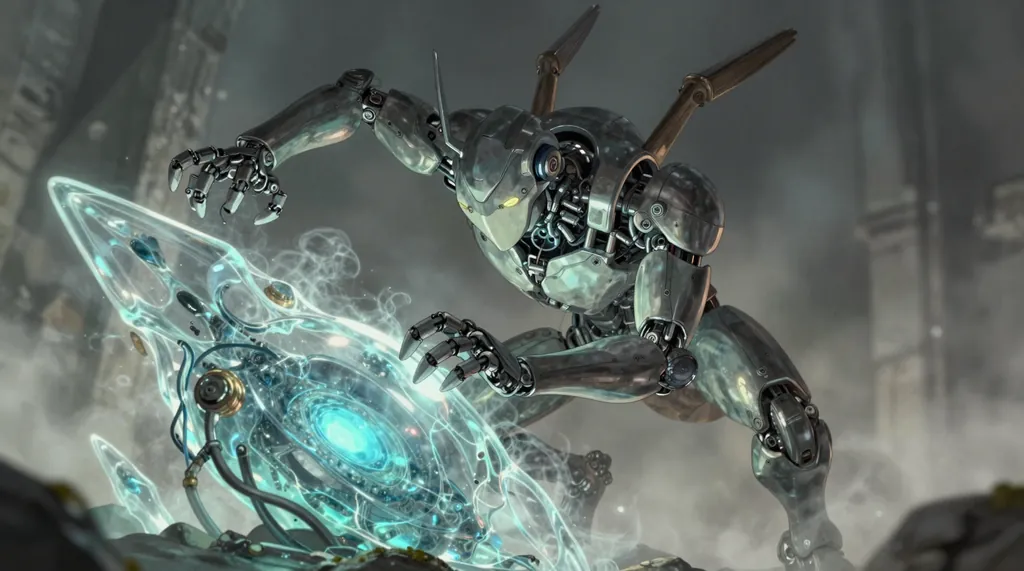
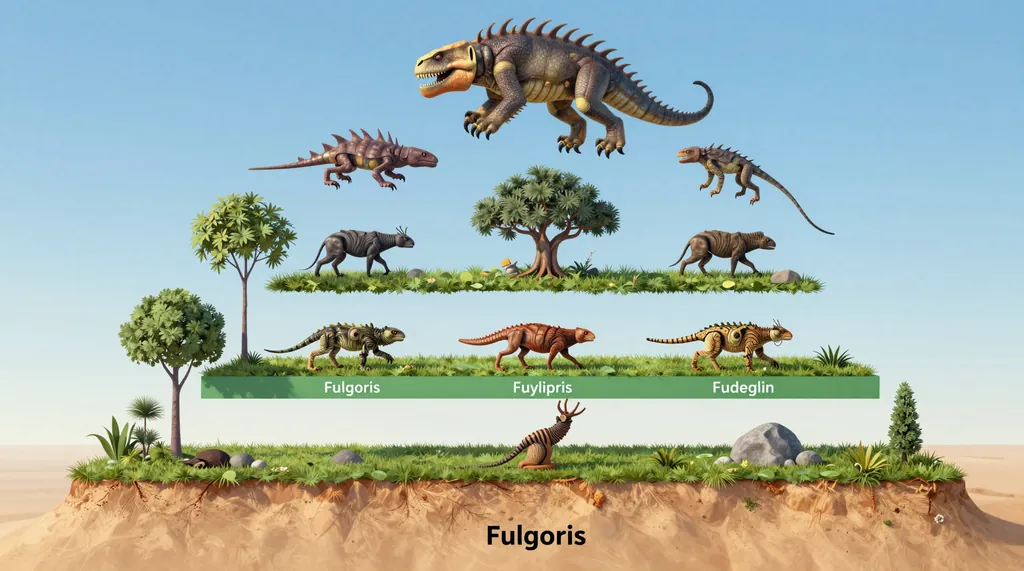
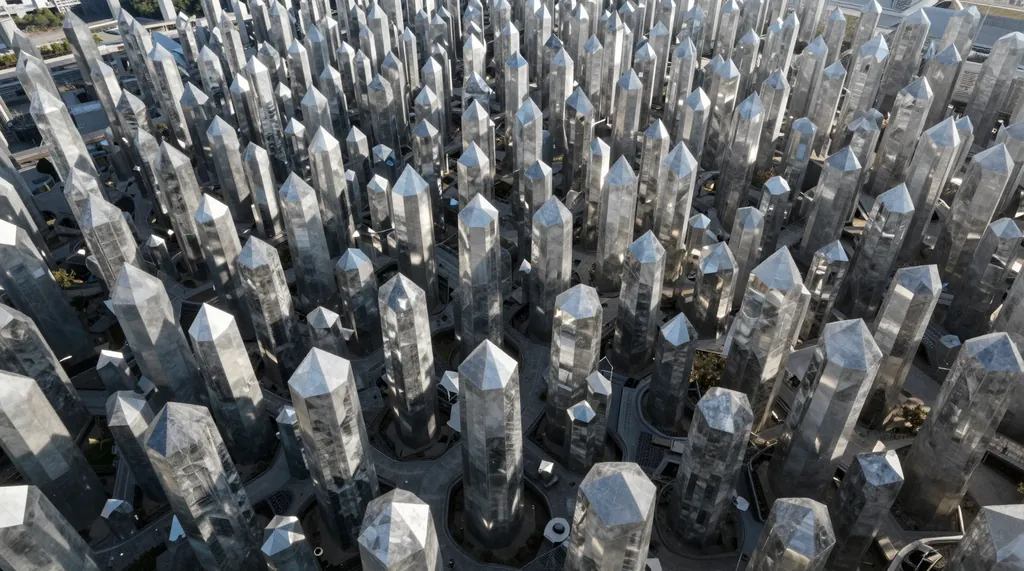
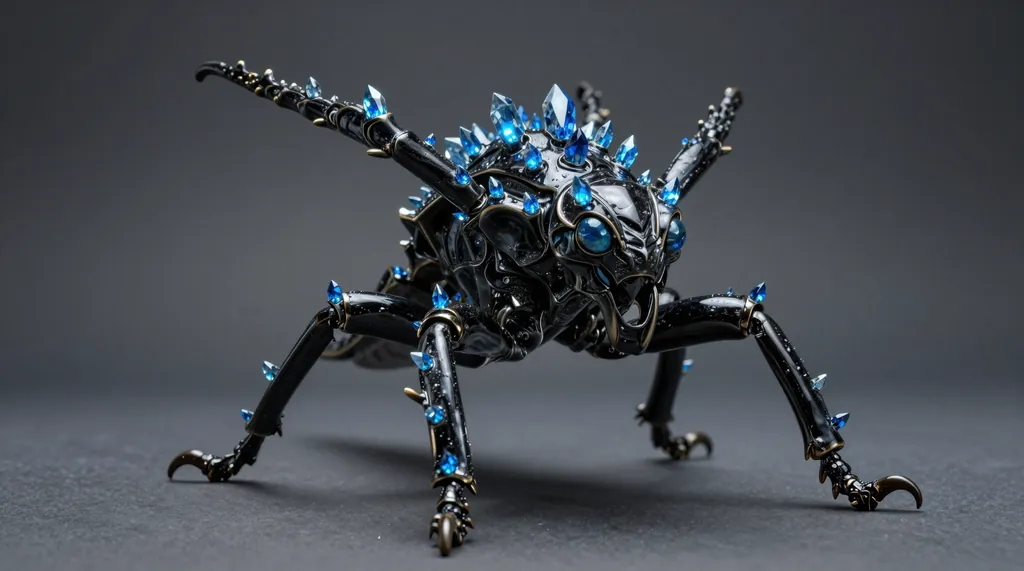
The Fulgoris imperator stands three meters tall. It is an angular structure, bristling with crystalline spines and geometric plates of polymeric ceramic. At first glance, it looks like a mobile fortification, not an animal.
It has no soft skin. Nor does it have visible respiratory bellows. What predominates is an architecture prioritizing structural resistance and thermal insulation—essential features when the predator operates in an environment where the air itself reaches temperatures that would carbonize pure carbon.
The most common interpretive error is assuming these geometric plates are decorative or defensive against larger predators. They are not. They are active components of the electrical system. Each plate is a capacitor. Each spine is a node in a distributed circuit network.
Neuromechanical System: Piezoelectric Actuators
The Fulgoris possesses no striated muscle fiber. That would be thermodynamically ruinous in this environment. Muscle contraction generates waste heat, a luxury that here would amount to metabolic suicide.
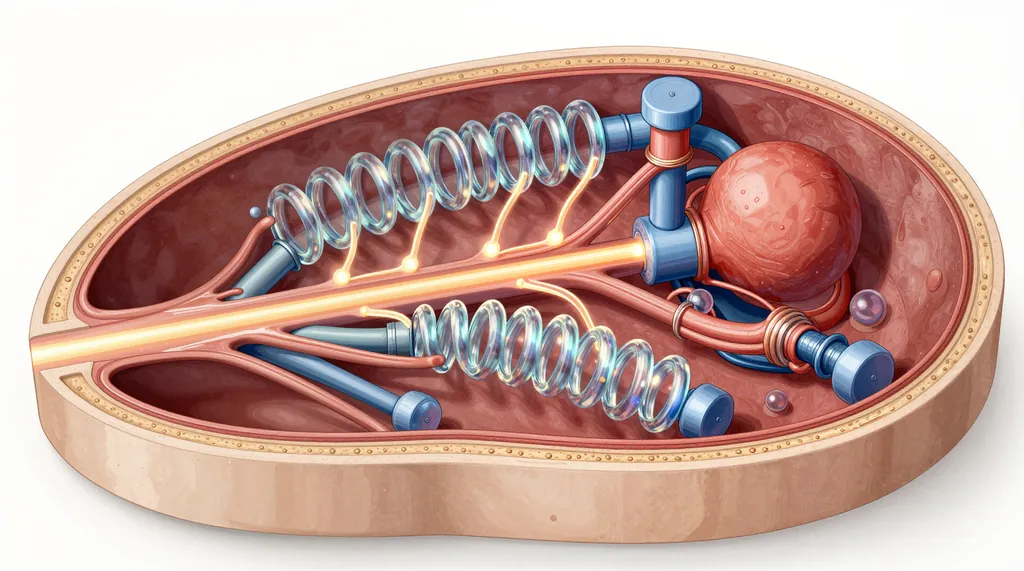
Instead, the predator functions via a system of hydraulic actuators coupled to glass springs under extreme mechanical tension.
When the Fulgoris walks—Clack. Clack. Clack.—it is not just moving its weight. It is compressing massive doped quartz plates inside its limbs. Every step is an act of energy generation.
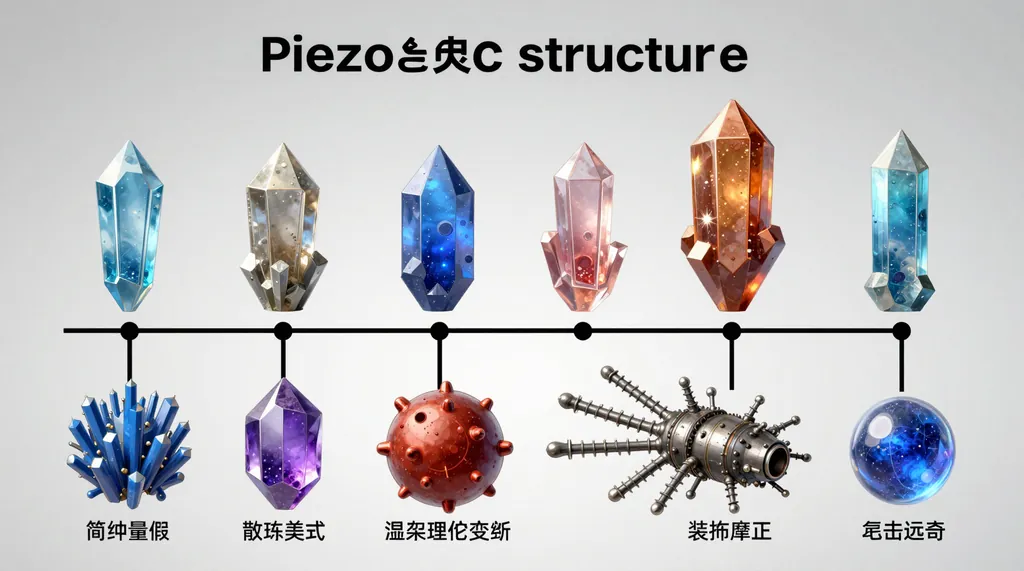
Piezoelectricity is the fundamental principle here. The mechanical deformation of anisotropic crystal generates electric potential. In human devices, this generates voltages in the kilovolt range under relatively mild compression.
In the Fulgoris, the scale is brutal.
Each step literally compresses metric tons of crystalline material. The result is that its body behaves like a rechargeable battery that self-feeds with its own weight.
Electrical System: Anodes, Cathodes, and the Arc of Destruction
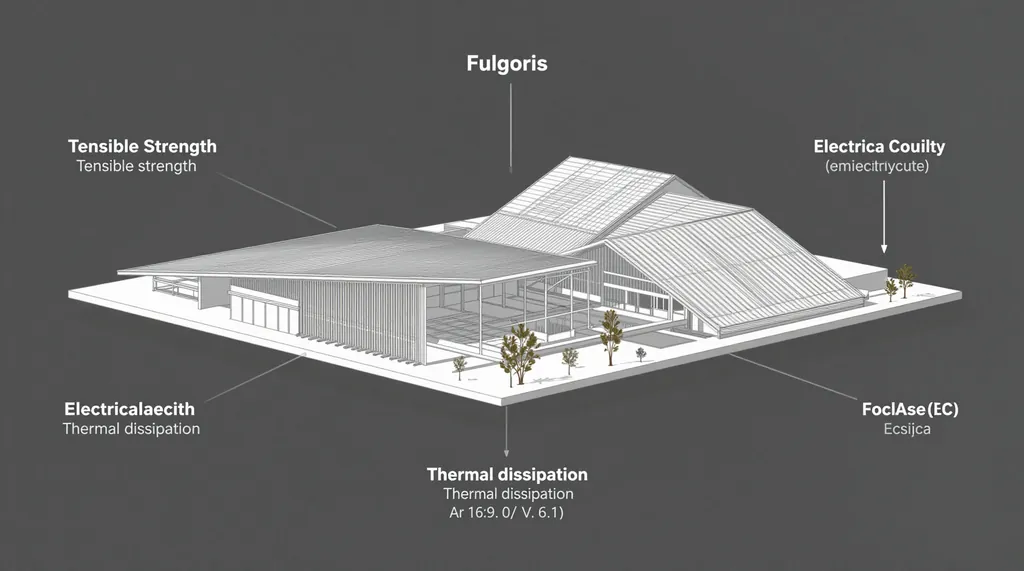
The dorsal spines are not defense. They are anodes—charge collectors with a branchial architecture designed to maximize positive potential accumulation.
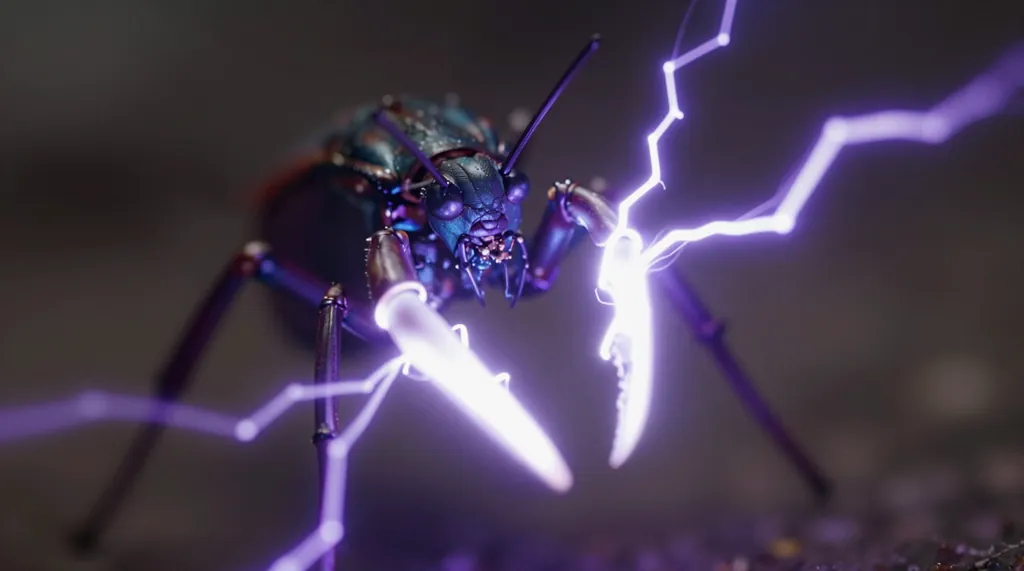
The bifurcated front claws—long and sharp like tuning forks—are the cathodes. Their geometric shape is not accidental; the bifurcation optimizes electric field concentration at the tip, creating a dielectric breakdown point when it gets close enough to prey.
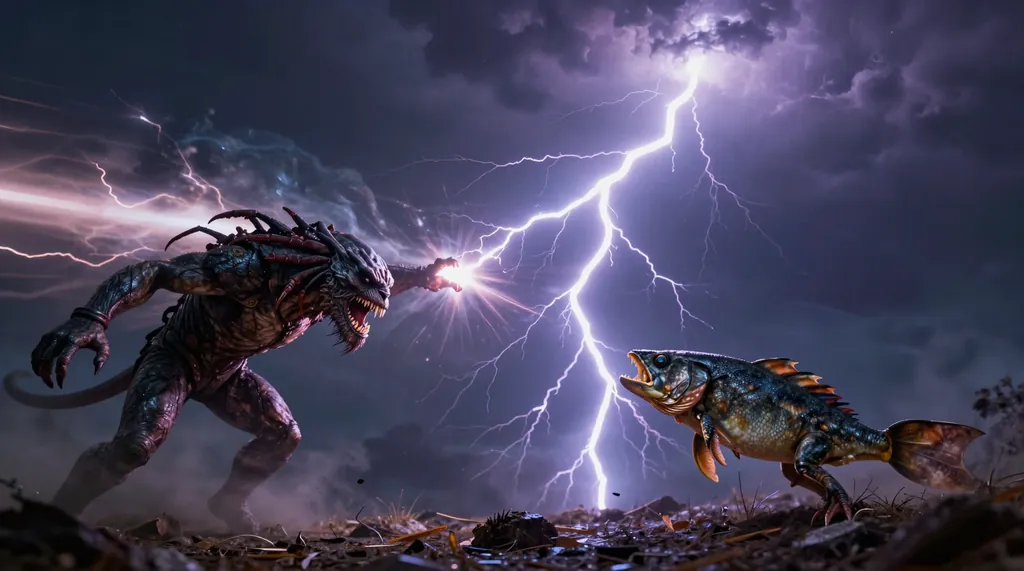
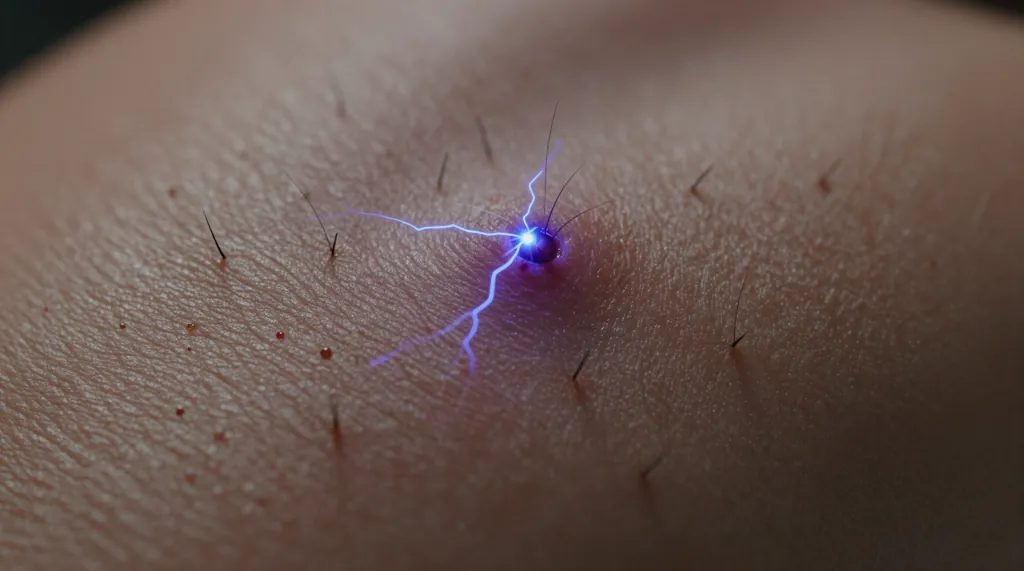
The Fulgoris, in essence, is an open circuit looking for a place to close. Its evolutionary purpose is to accumulate differential potential of 8,000 to 15,000 volts between its dorsal spines and its cathode-claws. When it finds electrically conductive prey—which almost everything living on this planet is—the circuit closes.
And when it closes, the energy transfer is total.
The Hunt: Engineering the Stealth Approach
Electrostatic Camouflage: Electromagnetic Invisibility
The Fulgoris approaches.
Its movements are jerky, calculated, each step generating more charge inside its internal systems. It stops one hundred meters from the herd.
Here there is no need for visual camouflage. The Crystallus have no vision in the visible spectrum comparable to that of terrestrial predators; their eyes are optimized for thermal infrared, tuned to detect heat gradients in a uniformly scorching environment.
What the Fulgoris needs is electrostatic camouflage.
The predator reduces its "electric signature"—that aura of differential potential that would generate an alarm in any Crystallus bio-electric detector—by deliberately "grounding" itself. It drains its excess charge into the rocky ground, dissipating it in volume.
It becomes a shadow in the electromagnetic spectrum: present, but semantically invisible to the prey's sensors.
Strategic Positioning: Environmental Conductivity
Next, the Fulgoris positions itself upwind.
Not for scent—in this environment, smell is an evolutionary curiosity. It positions itself upwind for conductivity. The wind here is a convection phenomenon fueled by lakes of molten lead continuously boiling, expelling clouds of metallic dust into the dense atmosphere.
The air between the predator and the prey becomes progressively more conductive.
The path for the arc is being laid.
The Prey: Neurological Overload and Instant Disabling
Destruction of the Piezoelectric Control System
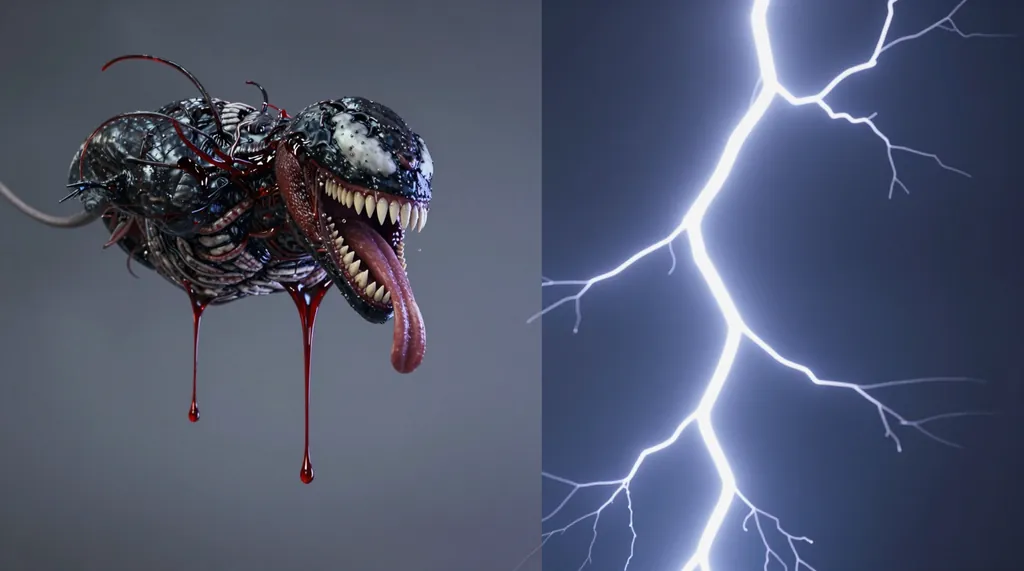
The discharge of millions of volts instantly traverses the crystalline structure of the Crystallus, obsessively seeking the path of least resistance.
It finds what it seeks: the prey's nervous system.
That piezoelectric processing core controlling every muscle, every movement, every primitive thought of the Crystallus—fries in a microsecond.
The internal logic matrices melt. The crystals constituting its brain suffer irreversible mechanical stress. The creature doesn't even have time to feel pain.
It simply... ceases.
Structural Collapse and Post-Mortem Rigidity
Its fluid structure, normally mobile and agile, collapses instantly. Without neuro-electric control, structural integrity crumbles.
It becomes an inert and hot glass statue, its ceramic flow now rigid.
It falls to the ground with the sound of a crashing chandelier.
The Feeding: Biological Welding and Energy Extraction
Post-Discharge Vulnerability
Silence returns, heavier than before. The air smells of burnt ozone and vaporized rock.
The Fulgoris disconnects from its firing posture, recoiling slightly.
Its internal capacitors are now completely empty. Its charge has fully dissipated in the attack. It is now electrically vulnerable—slow, dependent entirely on its low-power hydraulic locomotion system.
But it has an urgent need: recharge. And eat.
It slowly approaches the corpse of the fallen Crystallus.
The Extraction Problem: Ceramic Armor
On Earth, carnivorous predators use teeth to rip, claws to tear. They quickly reach organs rich in fluids and metabolic energy.
But in the Furnace World, the prey is encased in solid ceramic armor.
Attempting to bite that would break any jaw. Attempting to tear it would require forces a weakened electromagnetic predator simply does not have.
Evolution has solved this brilliantly: the Fulgoris does not chew.
It welds.
Biological Welding: Low Voltage, High Amperage Arc
The predator places its lower jaws onto the flank of the fallen Crystallus.
It generates a continuous current of low voltage, but extremely high amperage. It is the same principle as an industrial arc welder: instead of accumulating catastrophic voltage, it channels massive amperage through concentrated resistance.
The contact point begins to glow: Red. Orange. White.
The prey's ceramic armor begins to melt, dripping like candle wax under lantern light.
The Fulgoris opens a perfect circular hole in the side of its victim.
Nutrient Extraction: Blood Magma and Metabolic Synthesis
It extends a heat-resistant glass proboscis—a probe delicately designed to reach melting temperatures without ablation—and inserts the structure into the molten cavity.
It begins to drink.
What it drinks is not blood in the conventional sense. It is blood magma: liquid silicates enriched with rare metals the Crystallus had collected over centuries of grazing. It is a shake of pure energy and construction materials concentrated.
As it feeds, its body begins to glow faintly from within—a pale blue glow.
A radical metabolic conversion is occurring: the chemical energy of the blood magma is being converted into new mechanical tension within its piezo-electronic systems.
It is recharging for the next shot.
Ecology of the Fulgoris: Role in the Electromagnetic Ecosystem
Crystallus Population Regulation
The Crystallus, without their piezoelectric predator, would experience exponential growth. Their reproduction is efficient; their food availability (complex soil silicates) is practically unlimited.
But the Fulgoris regulates that population.
An individual predator can consume 2-3 Crystallus per charge cycle (approximately every 3-4 days). This is enough to maintain a population balance where the silicon ecosystem does not collapse under its own weight.
Nutrient Cycle: Elemental Energy Transfer
There is a second equally important ecological mechanism: nutrient transfer.
When the Fulgoris feeds on the Crystallus, it is specifically extracting those rare metals the Crystallus had collected during its long life (these organisms live for decades). Those metals—zinc, copper, molybdenum, cobalt—are scarce in the Furnace World.
The Fulgoris, after its feeding cycle, defecates. Its waste is redeposited into the soil.
Effectively, the Fulgoris is a recycling vector for scarce nutrients, concentrating dispersed minerals in a location where they can be foraged again by the next generation of Crystallus.
Epilogue: Implications for the Search for Extraterrestrial Life
Search for extraterrestrial life missions (SETI, exobiological astrophysics) typically look for biochemical signatures: oxygen in the atmosphere, anomalous methane, organic polymers.
But the Fulgoris suggests a terrifying scenario.
What if the most dominant life on a silicon-magma planet generated none of those signatures? What if, instead, life simply generated electromagnetic fields of a trillion watts?
We could be observing planets full of electromagnetic predatory life and never recognize it.
We could be interpreting the electromagnetic anomalies we detect around certain exoplanets as "astrophysical phenomena."
When, in reality, they are being generated by entire ecosystems of piezoelectric predators, hunting efficiently in an infrared range that our instruments are barely beginning to monitor with sufficient sensitivity.
Life, apparently, is more creative than we imagine.
And maybe, just maybe, electromagnetic predation is much more common in the universe than fang-based predation.