ACT I: THE LIVING DARKNESS
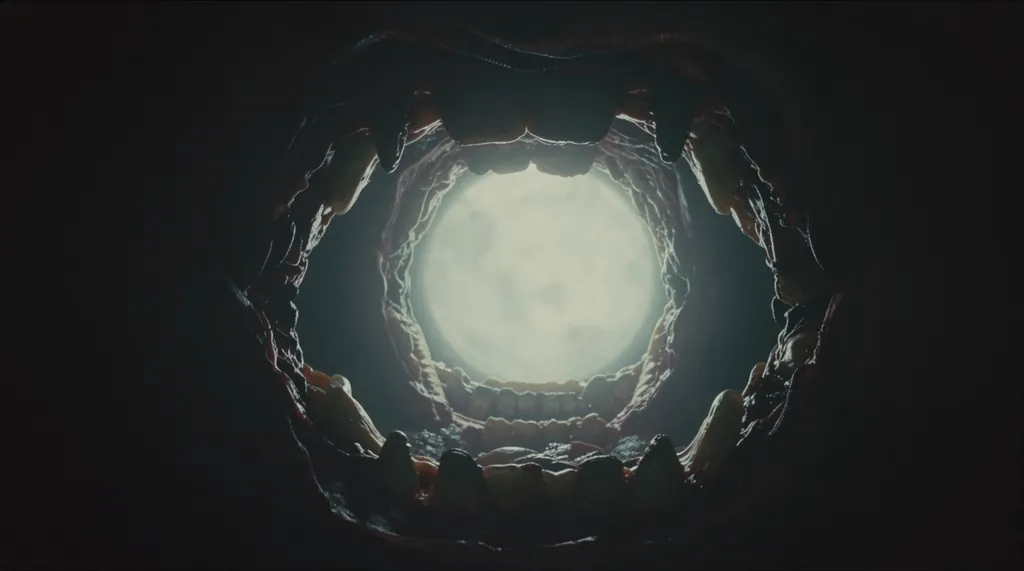
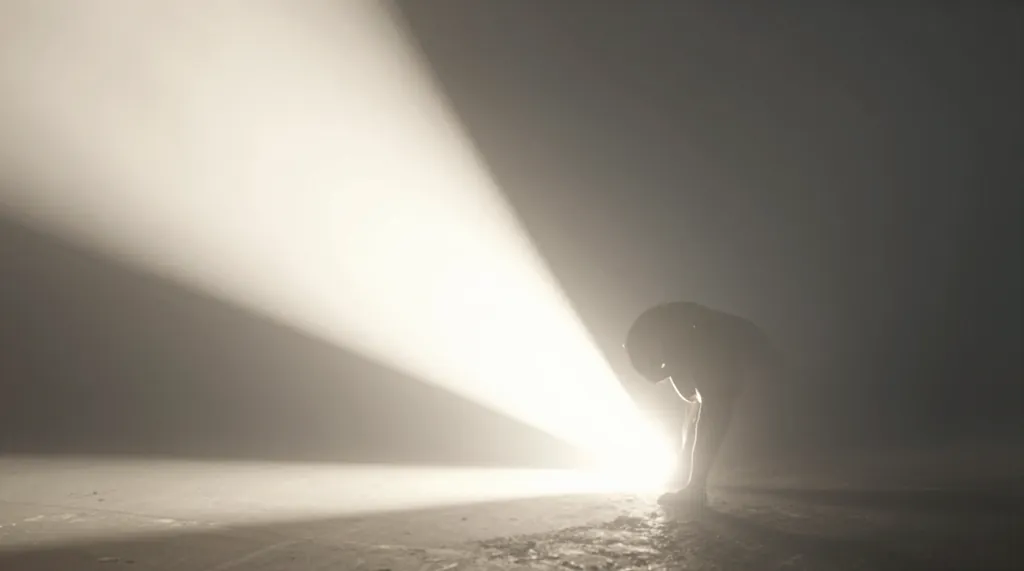
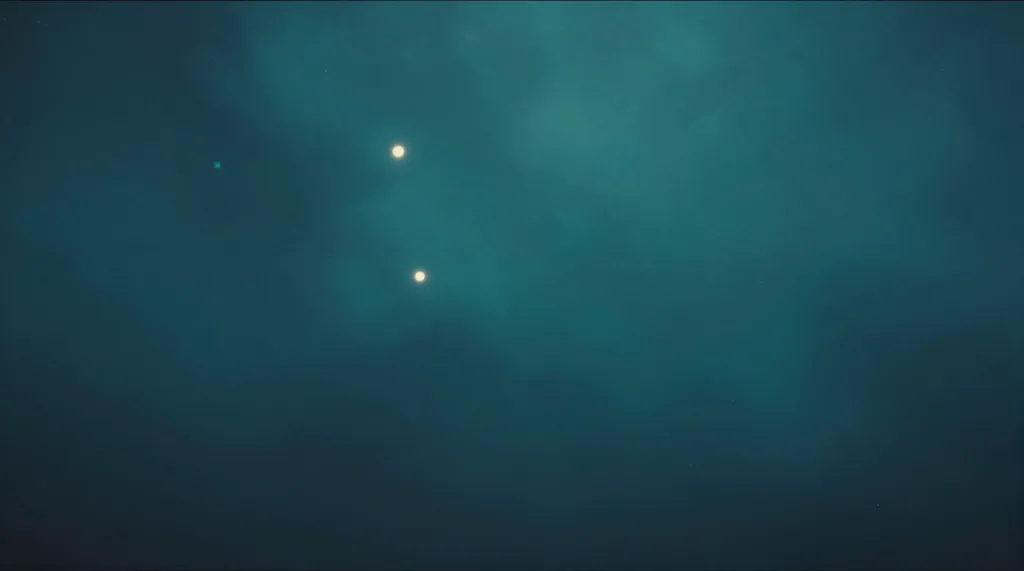
You are blind. Right now, your eyes are open, fully dilated, desperately searching for a single photon. But here, in the belly of a planet expelled from its solar system aeons ago, there are no photons.
There is no sun. No moon. No stars. Not even a reflection of distant radiation.
Darkness here is not a shadow. It is not the absence of light. It is a physical condition of the universe, the natural state when all solar energy is removed. It is a canvas of infinite ink stretching for thousands of kilometers in all directions.
By all rational logic, this should be a gray world. A world of touch, of smell, of vibration. A world where life would be founded on chemical and mechanical senses, completely ignoring the visible spectrum.
But life hates being ignored.
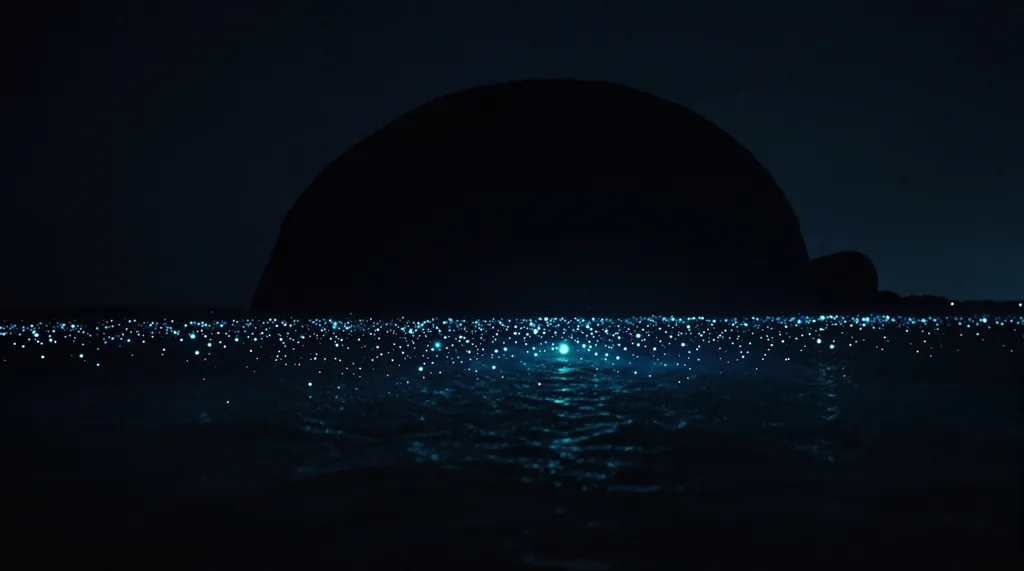
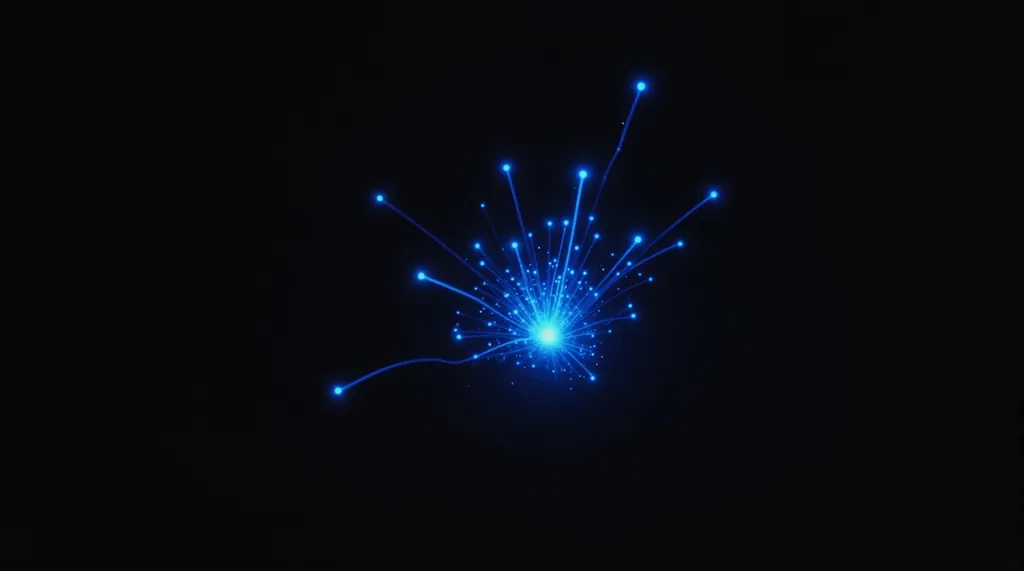
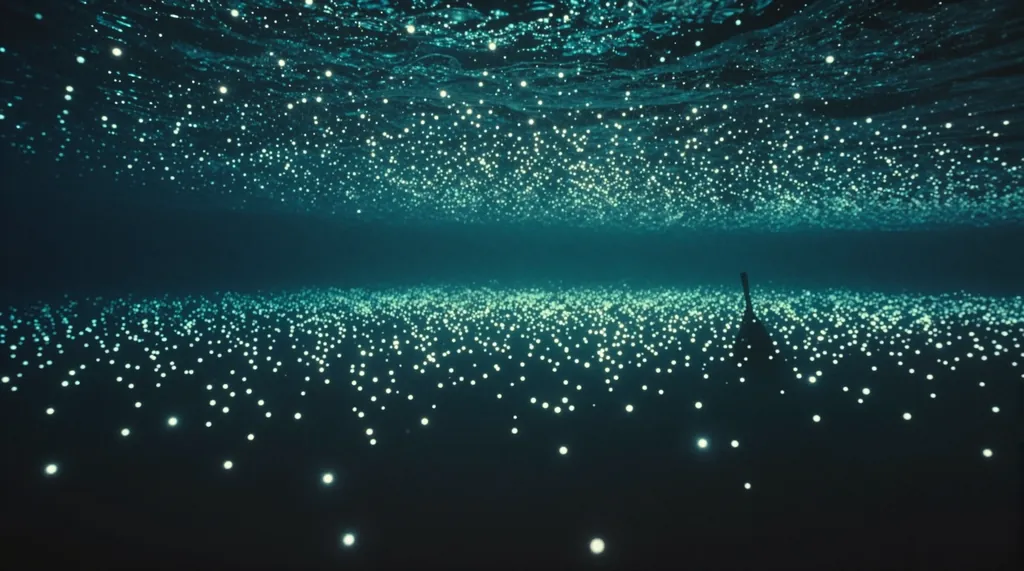
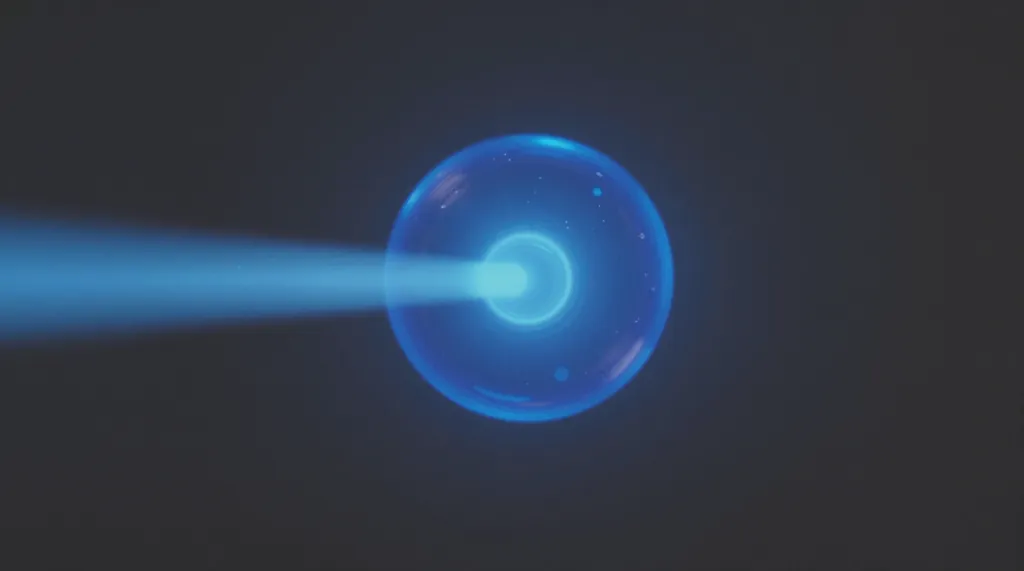
An electric blue dot lights up in the center of the blackness. It is small, but in this absolute contrast, it looks like a supernova. A liquid sapphire burning in the void. It blinks once. Twice. And then, another dot responds in the distance. And another. And another.
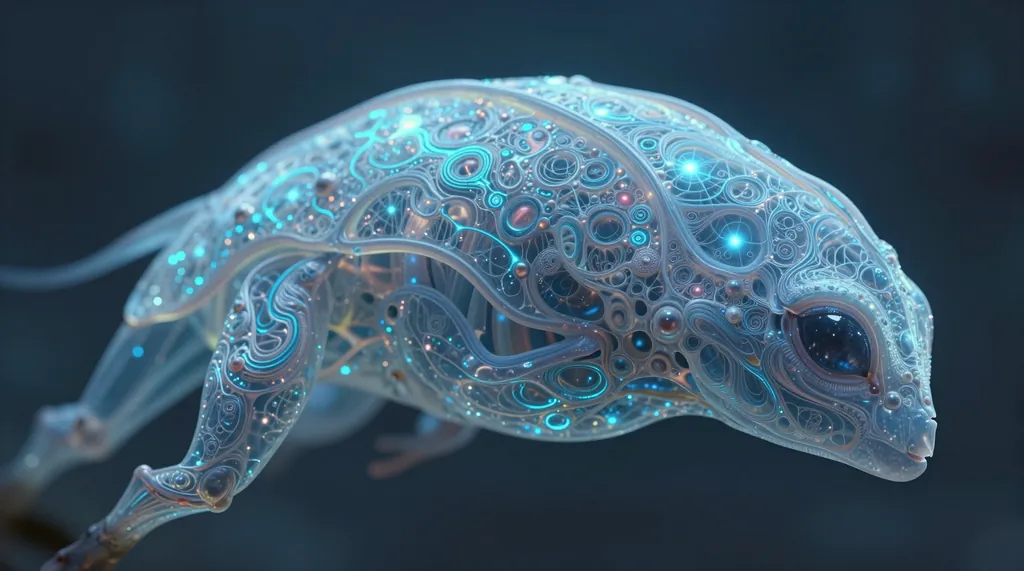
What you see is not the reflection of an external light. There are no flashlights here. There is no radiation bouncing from above. This light comes from nowhere. This light comes from within.
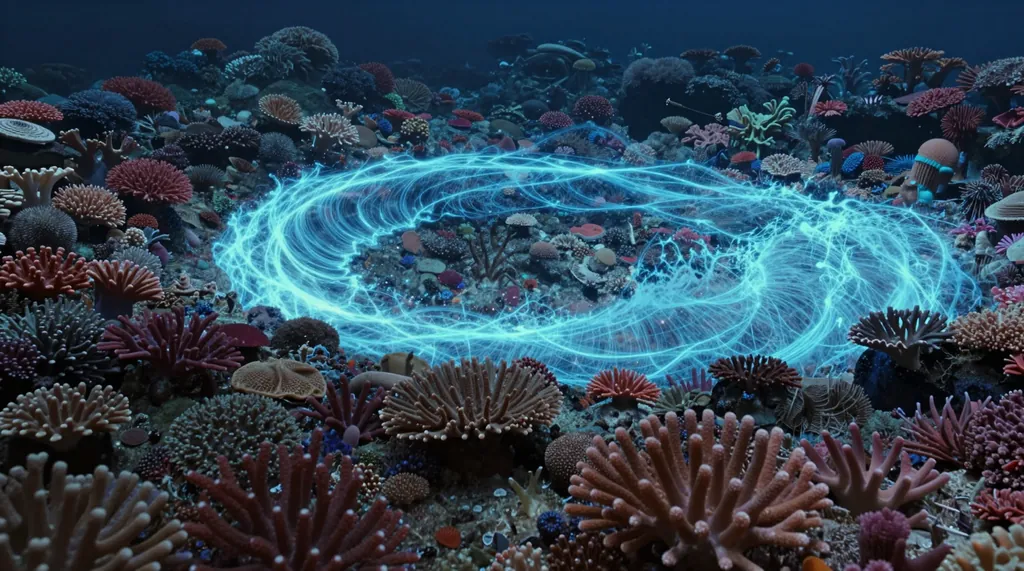
The camera pulls back. And back. And back. It is not a dot. It is not an isolated flash. It is a neon metropolis. A floating city of pulsating light. Gigantic reefs glowing with hypnotic patterns, schools of fish moving like rivers of luminous mercury, jellyfish kilometers long looking like thunderstorms trapped in gelatin.
Welcome to the Bioluminescent Network.
It is the grandest fireworks show in the galaxy, and it happens in absolute silence, under twenty kilometers of dense ice. It is a dizzying paradox: in a world of the blind, on a planet where darkness is the only safety, these beings have evolved to become living art. They have rejected camouflage. They have chosen visibility.
Why glow when glowing is dying?
On Earth, animals camouflage to disappear. They mimic their environment. The universal pattern is: invisibility = survival. But here, evolution has taken a different path. A more arrogant path. A more dangerous path.
Here, life has decided to become fire.
But make no mistake. This beauty is not ornamental. It is not purposeless evolutionary decoration. It is not art for art's sake.
Every flash you see is a word. Every pulse of color is a sentence in an ancient and deadly language. Every sequence of light is a declaration of intent.
"I am here." "I am strong." "I am hungry." "I want to mate." "I am poisonous." "Stay away or die."
In eternal darkness, where there is no other means of communication that can be transmitted through dense and cold water, light is the only voice that matters. It is the only language that works.
And it is also the oldest trick in the book.
ACT III: THE PRODUCERS — THE NEON GARDEN
Let's go down to the ocean floor. Beyond open water. To the seabed where the mud rests.
To the Neon Garden.
Here live those who cannot flee. Those who do not have the ability to swim. Those anchored to the rock. Sessile organisms—literally stuck to the ground, impossible to move, condemned to remain in one place forever.
You might think these beings should hide. That they should adopt dark colors, that they should blend in with the surrounding mud, that they should disappear into the blackness. After all, they cannot run. If they are visible, they are vulnerable. If they glow, they are easy food for any predator passing by.
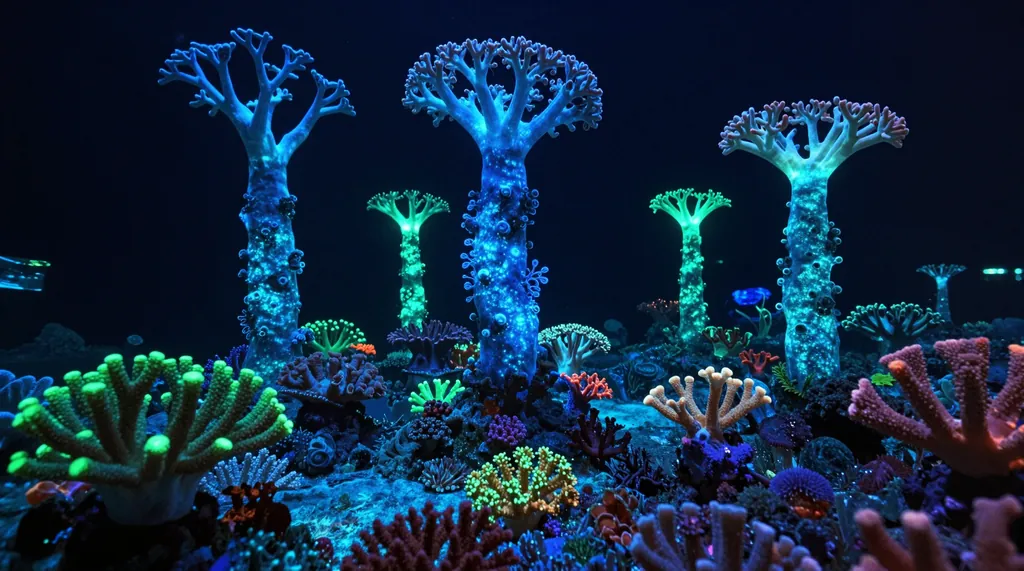
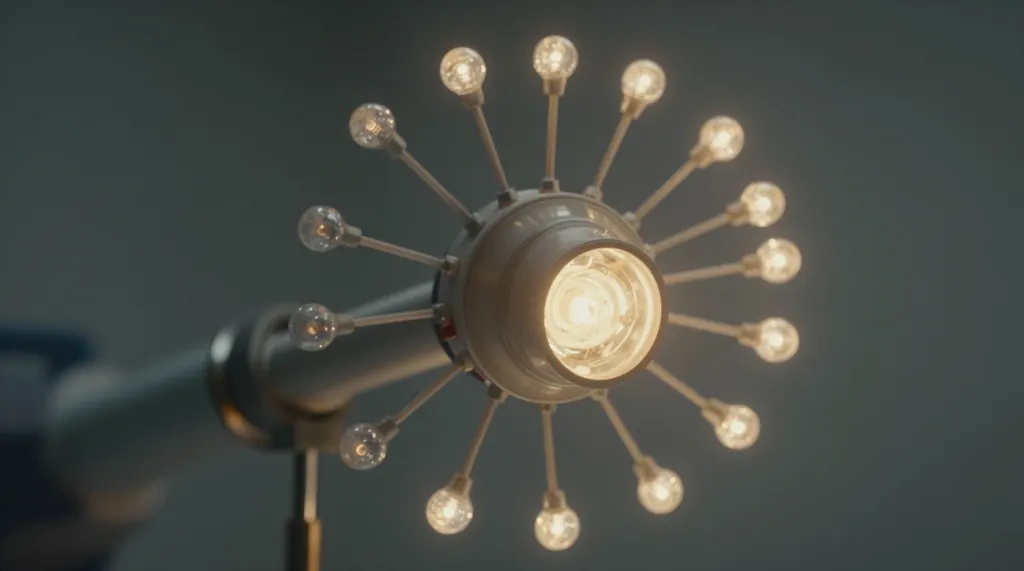
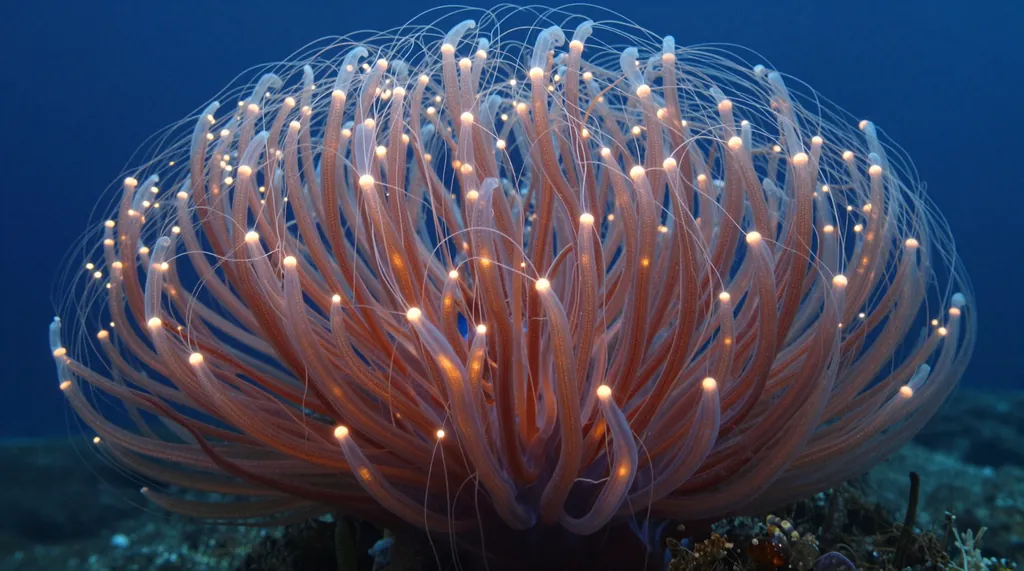
But look. They are beacons. They are trees of constant pulsating light. They glow ceaselessly, emitting light in rhythmic patterns. They are doing exactly the opposite of what survival logic would suggest.
Why?
Because these organisms have solved the equation differently. They have decided that invisibility is not survival. That hiding is death. That the only viable strategy for an organism that cannot move is to be the most visible, brightest, most impossible-to-ignore thing in the entire ecosystem.
They are colonies. Thousands, millions of small individual polyps—tiny animals, each the size of a pinhead—that have fused into gigantic structures. Some polyps are filter feeders, capturing particles from the water. Others are light producers. Others are specialized predators. Others are pure structure: biological skeleton.
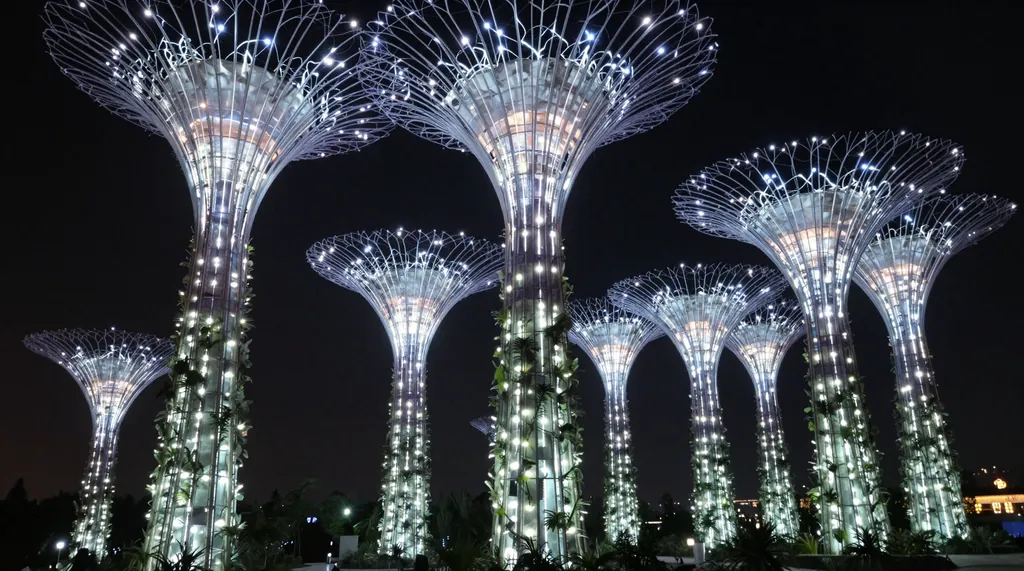
These structures, tall as terrestrial oaks, are cathedrals of light. Huge towers, columns, domes, all built of silica or calcium carbonate, all alive, all glowing in coordinated patterns.
Observe the light pattern. It is not chaotic. It is not random. One end of the reef lights up. Then the adjacent segment. Then the next. A wave of blue light travels across the entire structure like a stadium wave, but backwards. A reverse wave. A wave of biological communication traveling at the speed of chemical reactions through living tissue.
Absolute synchrony. Perfect. Rehearsed by millions of years of evolution.
What is happening? What are these creatures communicating?
They are talking to each other. Or perhaps, they are screaming together to seem bigger. When a predator descends from above and touches the reef structure, the alarm signal propagates instantly through the entire network. The whole forest blinks in a violent stroboscopic pattern, as if it were a failed firework, as if every light pulsed uncontrollably.
The goal is absolute confusion. It is the dazzle effect. For a predator with ultra-sensitive eyes, designed by millions of years of evolution to detect a single photon in absolute darkness, this forest is not pretty. It is agony. It is physical pain. It is like looking directly at the sun with fully dilated eyes.
The forest uses its light as a weapon. As a cinematic energy shield. It overloads the enemy's senses, leaving it momentarily blind, stunned by excess sensory information, confused and disoriented.
But light is also a lure.
It is a trap. A trap refined by millions of years of evolution.
Plankton, bioluminescent bacteria, small crustaceans inhabiting these waters have an ancestral instinct: positive phototropism. They swim toward the light. It is a behavior so fundamental to their biology they cannot resist. It is not a conscious choice. It is a reflex, an impulse as deep as a heartbeat.
So these trees of light glow not only to defend themselves. They glow to fish. They are static fishermen. Builders of cathedrals that are also traps.
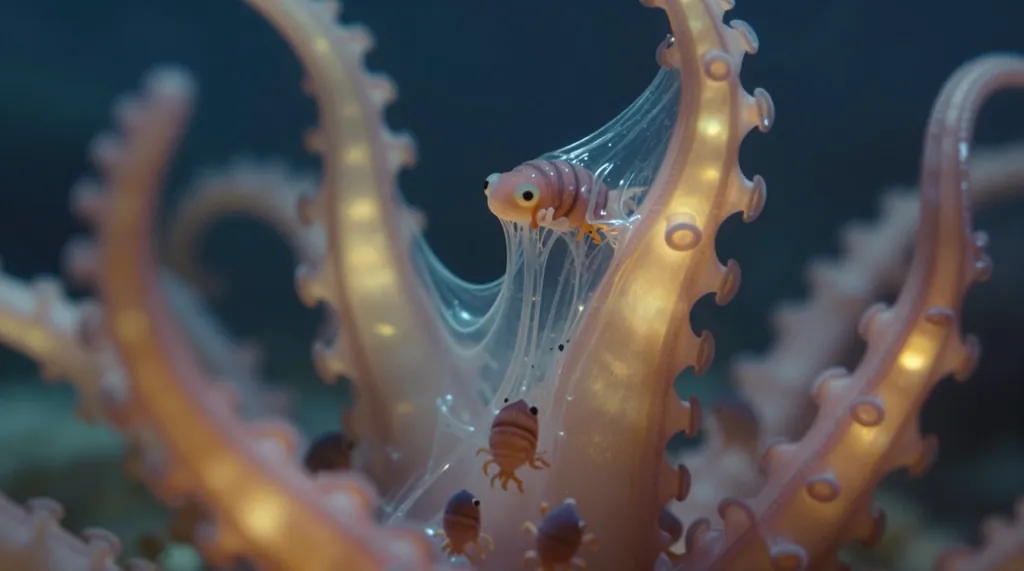
Every glowing tentacle is an extended tongue, waiting to lick the water full of insects attracted to the flame. They are cages of light where captives get trapped in sticky mucus, in poisonous nematocysts, in digestive acid.
It is beautiful. And it is ruthless. It is art and slaughter simultaneously.
ACT V: THE FALSE DAWN
But there is a legend. A story whispered through panic vibrations among schools of fish. A story spreading like a horror movie in the ocean's vibrational language.
It is the legend of the False Dawn.
Look up.
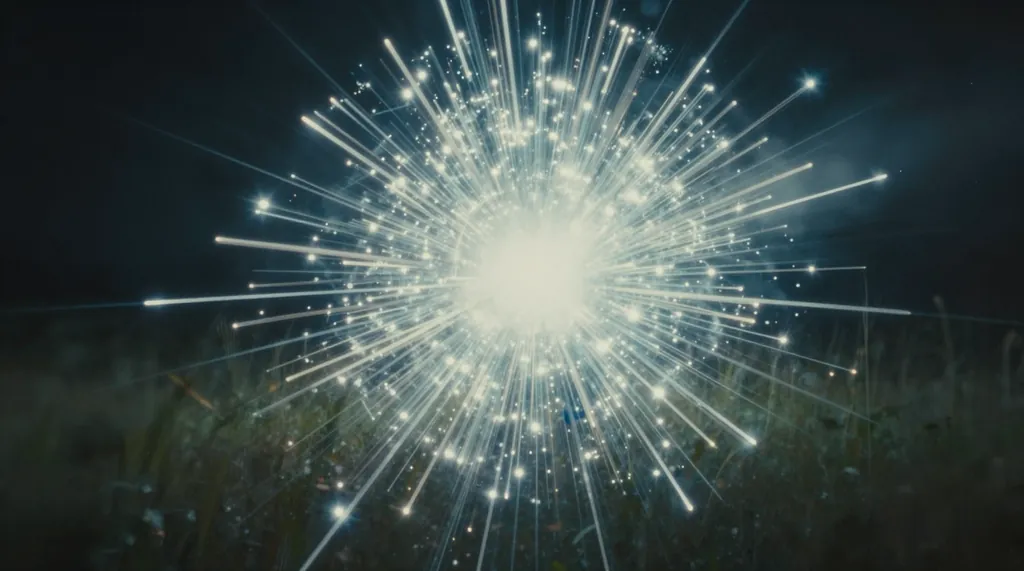
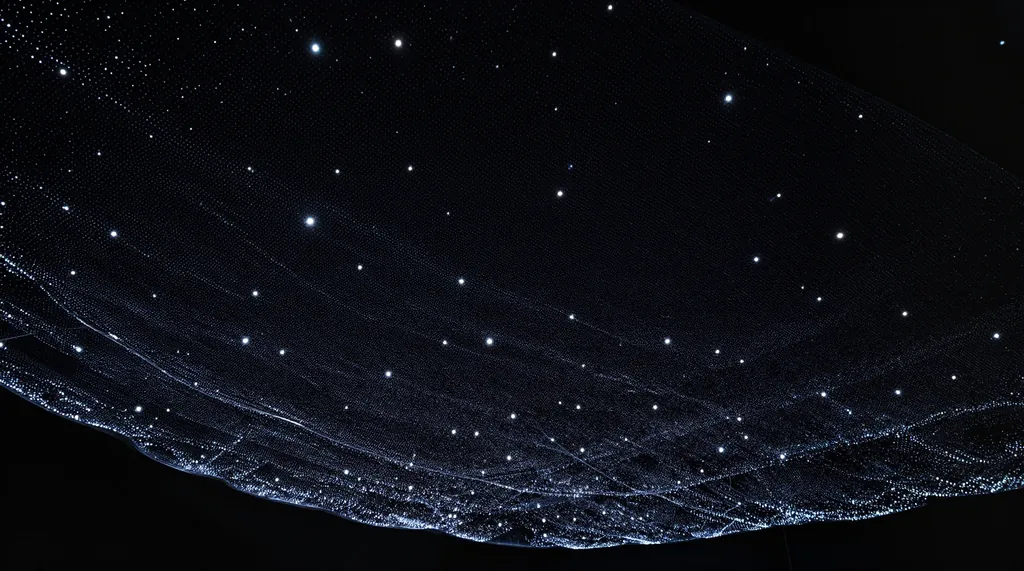
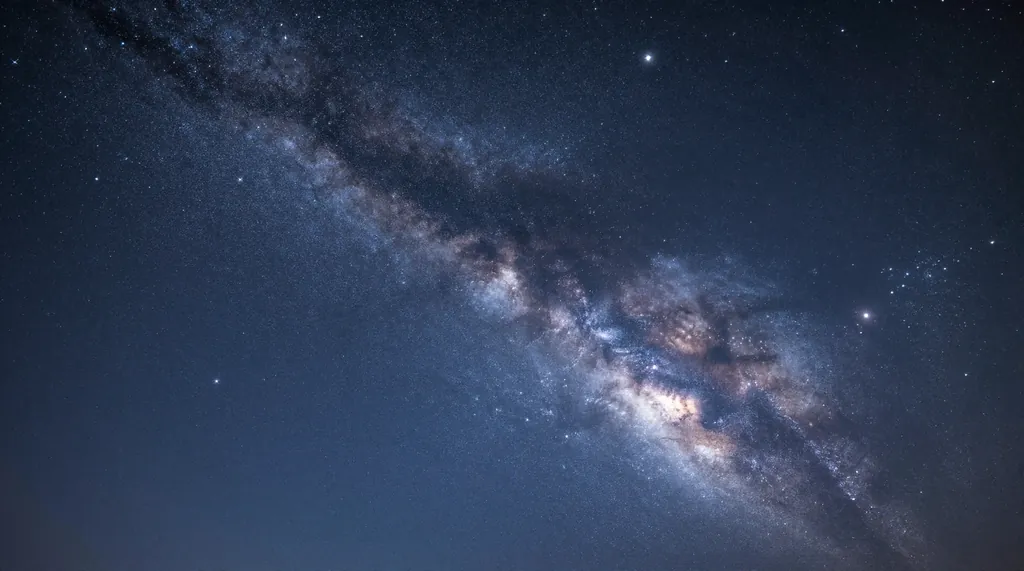
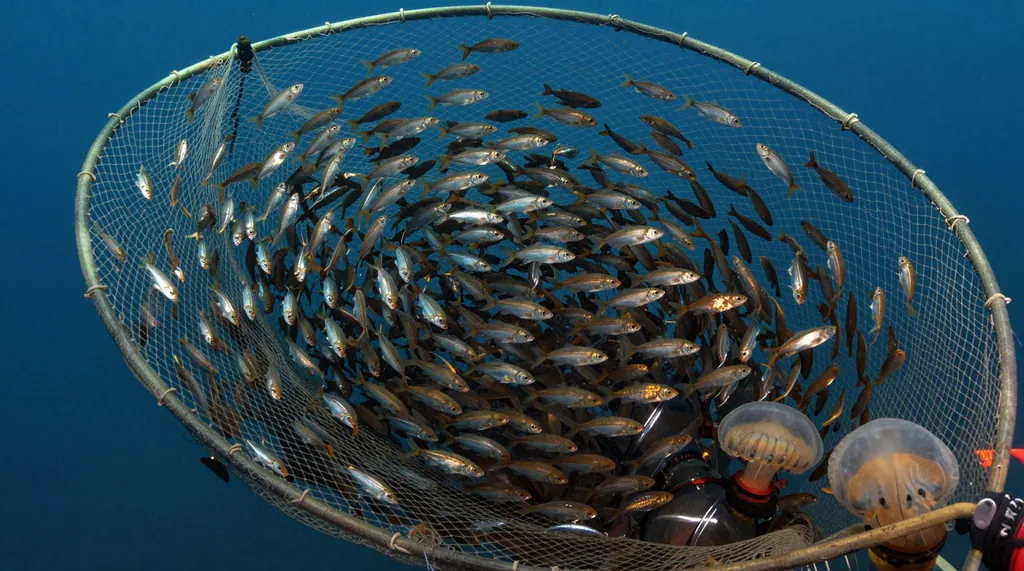
It looks like a sky. A real sky. It looks like the ice has broken and you are seeing the real stars of the outer universe. Thousands of points of white and blue light, scattered like a miniature Milky Way, like a projection of the cosmos in miniature.
It is beautiful. It is serene. It is reassuring.
It is vast. It is almost infinite. Each point of light represents an opportunity: food, shelter, safety.
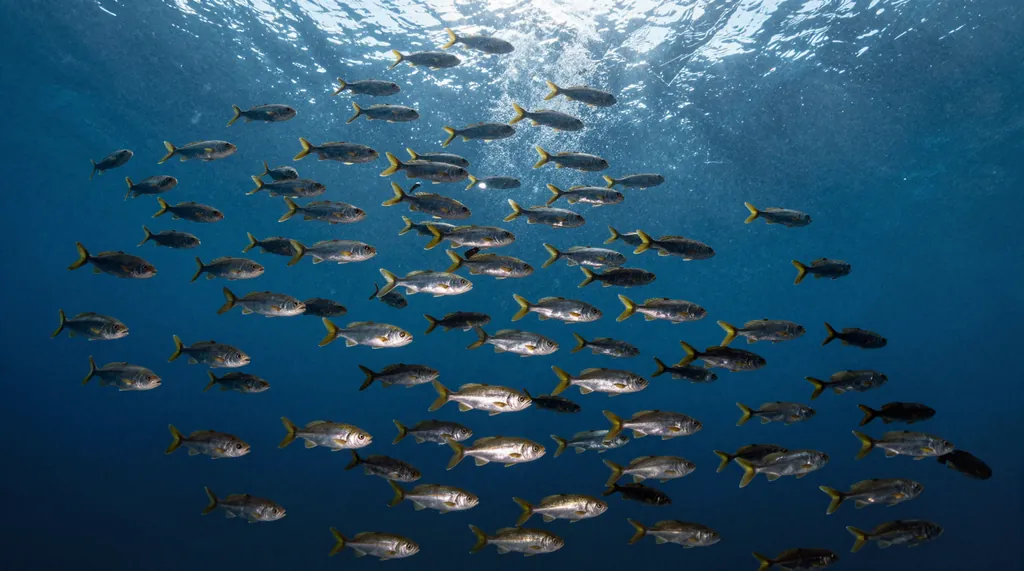
For a school of small fish, tired of fleeing darkness monsters, invisible predators, hunters hiding in blackness, this looks like absolute safety. Instinctively, fish associate that diffuse and extended light with the surface. With plankton descending from above. With home.
Hundreds, thousands, tens of thousands of fish begin swimming upward. Rising toward the light, hypnotized, seeking refuge in that artificial galaxy. Their positive phototropism activates. Their ancestral instinct to swim toward light dominates them. They cannot resist.
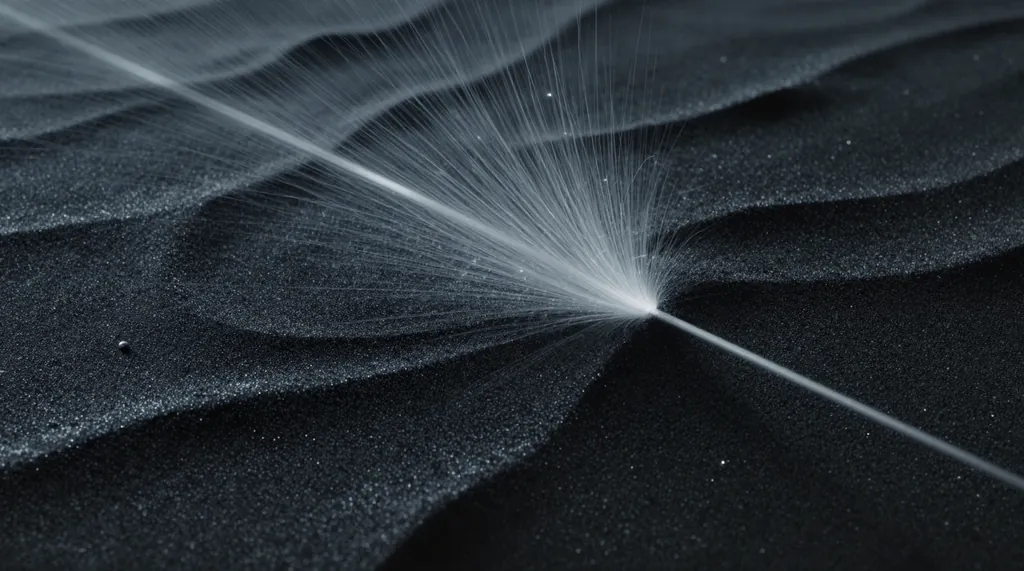
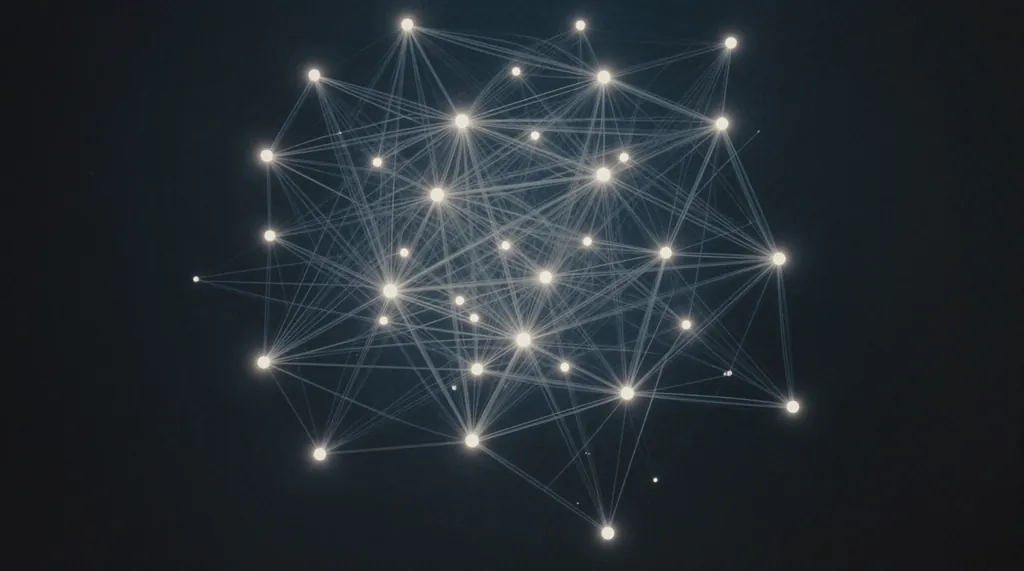
But as they get closer, perspective changes. The "stars" are not far away. They are surprisingly close. And they are connected. They are joined by almost invisible threads of gelatinous tissue. Filaments fine as hairs. Connecting each light to the next. Connecting every point of the false galaxy to all others.
It is a net. An immense net kilometers wide, kilometers deep, floating in the water like a cosmic sheet.
It is not a sky.
It is a Giant Colonial Siphonophore. A single creature composed of millions of cloned polyps, each an exact genetic copy of the other, each functioning as a cell in a megaorganism. Some of those polyps are stomachs. Others are engines, muscles propelling the whole structure. Others are gonads, reproduction. Others are tentacles, defense. And others... others are the stars.
They have woven a net of bioluminescent light spanning square kilometers. The entire structure is a gigantic organic photocell. A biological solar collector. A hook.
They have created a false horizon to deceive not an individual fish, but entire populations. Thousands of prey simultaneously. It is predation on an industrial scale. It is pure biological engineering.
When prey density is sufficient, when fish schools are close enough, densely packed enough...
The sky falls.
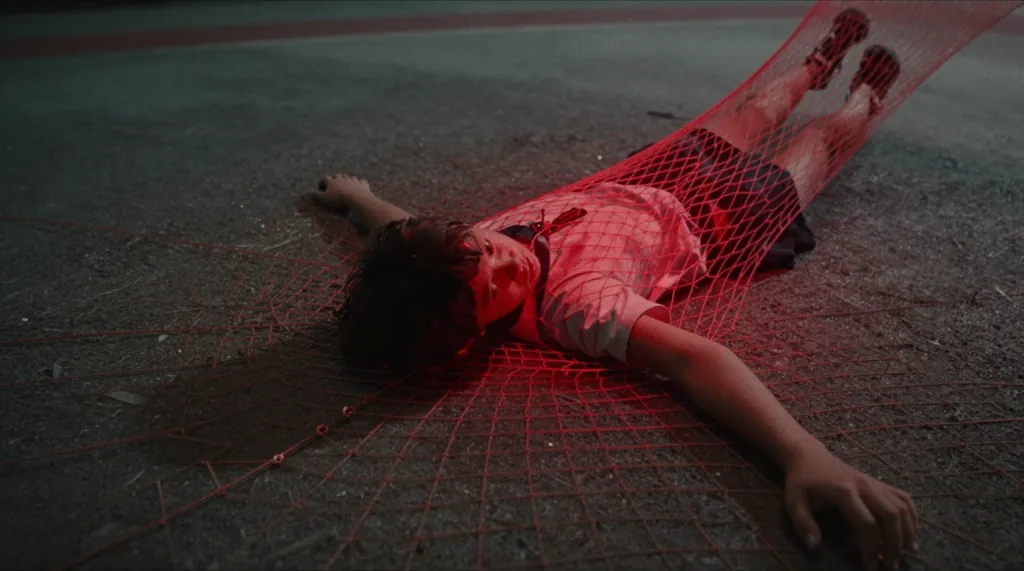
The net contracts. Not slowly. Not gradually. Instantly. From peaceful white to blood red in a millisecond. The transition from hope to horror in a tenth of a second.
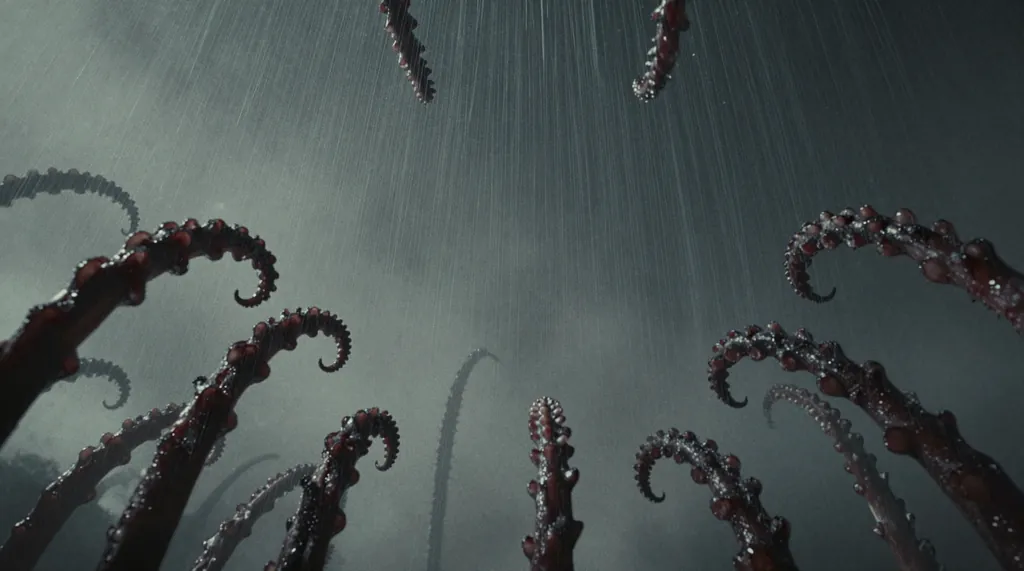
Millions of tentacles descend. Tentacles fine as hairs, so delicate they could almost be invisible, but loaded with nematocysts—specialized stinging cells—and poison. They descend like a rain of poisonous needles. Like a shower of death.
The school of fish panics. Absolute hysteria. They swim in all directions. Try to escape. But there is no exit. The net surrounds them. Beauty has become a cage. A cage of light. An electric cage.
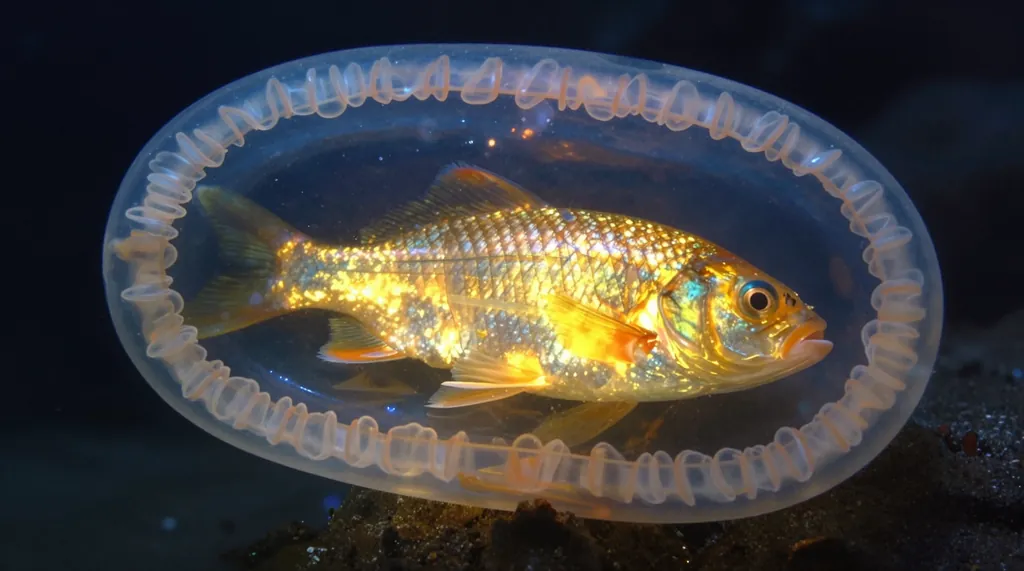
In a matter of minutes, the entire school is paralyzed. Every fish is stung. Every one injected with poison. Every one immobilized. They remain suspended in water, incapable of movement, incapable of escape, conscious but frozen.
And then digestion begins.
The False Dawn begins to digest them slowly. Dissolves their bodies in acid. Extracts nutrients. Breaks them down into basic components: proteins, fats, minerals. While doing so, the fish still glow. Still emit light. Their own natural bioluminescence continues while they are digested alive.
It is predation on an industrial scale. A shining slaughter. A bioluminescent holocaust.
ACT VI: FINAL REFLECTION
We, creatures of light from a planet blessed by a stable sun, have an obsession with luminescence bordering on reverent.
We love light. For us, light is truth. Light is knowledge. Light is divinity. Human cultures have built entire religions around the concept of divine light. Western philosophies speak of enlightenment. Light is good. Light is salvation.
We light bonfires to scare away monsters. Build cities of light to defend ourselves from the night. Our entire biology is optimized for visible light vision. Our eyes are photon processing machines. Our mind understands the world through reflected light.
For us, light is protection.
But here... here everything is different. Here, the inversion is total. Here, light is the monster.
In the Bioluminescent Network, beauty is always a warning. Always. Without exception. A flash of color is not a work of art. It is a loaded weapon. A war cry. A trap. A promise of death.
If you glow in this ocean, someone is using it as a lure. Someone is using your light to fish for others. Someone is using your glow as bargaining currency.
If you see a beautiful, warm, inviting light in the blackness, navigating toward you, promising safety, promising plankton, promising home...
Do not swim toward it.
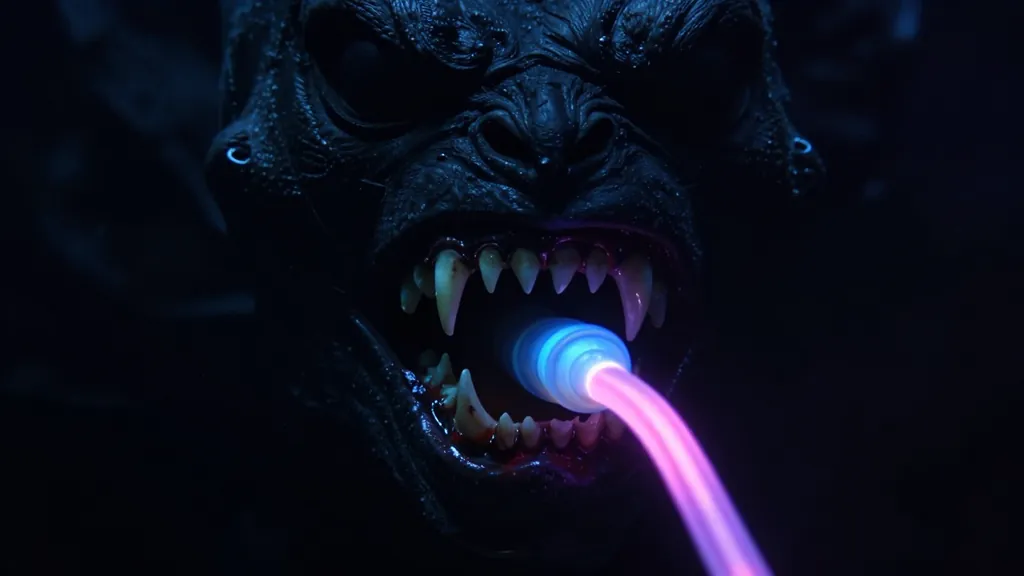
Turn around. Embrace the cold. Hide in the blackness. Because that light is almost certainly the throat of something that has been waiting for you for a thousand years. Something that has evolved exclusively to consume you. Something that has the time and patience of the deep ocean.
Light reveals, but darkness protects.
In the Bioluminescent Network, glowing is a confession. It is a declaration of presence. It is an invitation to die. And the universe usually accepts that invitation with enthusiasm.
The Dark Wanderers Saga has taught us a fundamental truth challenging everything we know as solar creatures.
Life does not need the sun. Life does not need radiation from a stable, distant star. Life can be its own sun. Can generate its own light. Can create its own fire.
In the deepest darkness, where no stellar radiation has ever touched, the will to exist burns with an intensity no star can match. Life in the absence of sunlight is not an accident. Not a fluke. It is a triumph of evolution.
But that triumph comes at a price.
The price is that every light is suspect. Every glow is a trap. Every flash of color is a lie waiting to be believed.
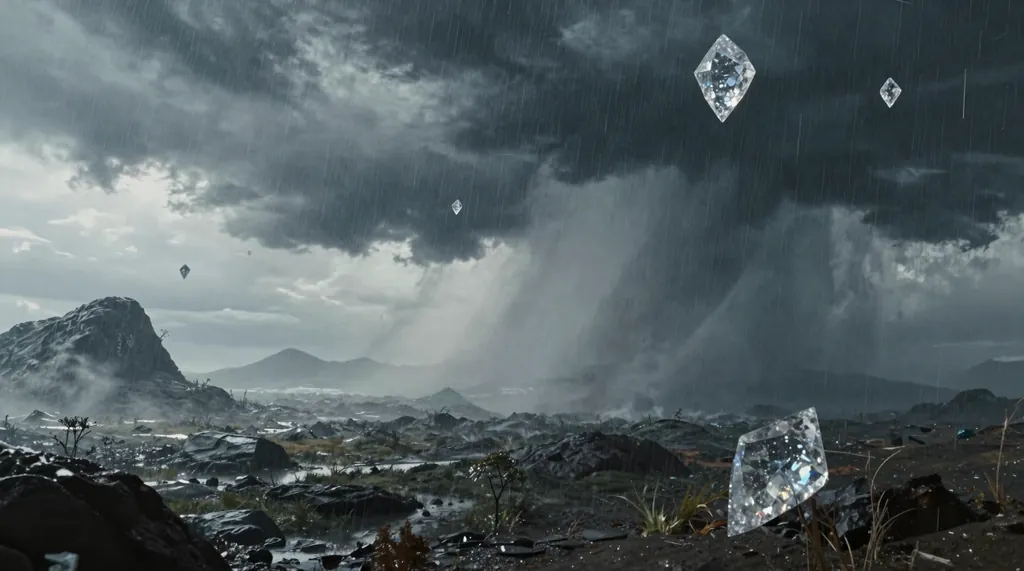
The next saga will take us to places where even cold light is not enough. To worlds where the atmosphere itself is a threat. Where it rains liquid glass. Where wind blows at speeds that can pulverize rock. Where weather is not a meteorological phenomenon—it is a serial killer.
Prepare for Hellish Climates.
Because the universe still has secrets. And life still has surprises.